


Anti-mScarlet3-H, AlpSdAbs® VHH(Biotin)
Code: 028-101-004
Specification: 100ug / 1mg
Applications: WB,ELISA,IP
Reactivity: mScarlet3-H
Conjugate: Biotin
Advantages:
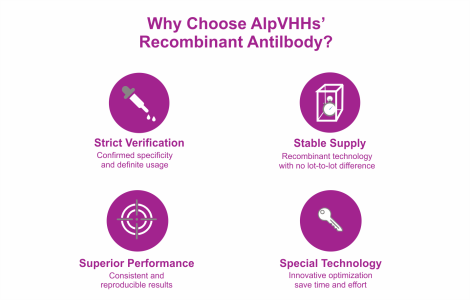
High lot-to-lot consistency
Increased sensitivity and higher affinity
Animal-free production
Product Detail
Product Detail
Description:
Anti-mScarlet3-H, AlpSdAbs® VHH(Biotin) is designed for detecting mScarlet fusion proteins. Anti-mScarlet3-H, AlpSdAbs® VHH(Biotin) is based on monoclonal, recombinant, single domain antibody to mScarlet coupled to Biotin. Based on immunoelectrophoresis and/or ELISA, Anti-mScarlet3-H, AlpSdAbs® VHH(Biotin) detects the mScarlet selectively, no reactivity with other proteins.
Immunogen: mScarlet
Host: Alpaca pacous
Isotype: VHH domain of alpaca IgG2b/2c
Conjugate: Biotin
Specificity: mScarlet,mScarlet3,mScarlet3-H
Cross-Reactivity: Highly selective for mScarlet
Purity: Recombinant Expression and Affinity purified
Concentration: 1mg/ml
Formation: Liquid, 10mM PBS (pH 7.5), 0.05% sucrose, 0.1% trehalose, 0.01% proclin300
Storage: Store at -20 °C(Avoid freeze / thaw cycles)
Background:
The fluorescent protein mScarlet is a truly monomeric red fluorescent protein with record brightness, quantum yield (70%) and fluorescence lifetime (3.9 ns). mScarlet outperforms existing red fluorescent proteins as a fusion tag, and it is especially useful as a Förster resonance energy transfer (FRET) acceptor in ratiometric imaging.
VHH are single-domain antibodies derived from the variable regions of heavy chain of Camelidae immunoglobulin. The size of VHH is extremely small(<15KDa) compared to other forms of antibody fragment, which significantly increase the permeability of VHH. Thus VHH is considered of great value for research, diagnostics and therapeutics.
Performance
WB: 1:5,000-1:20000
ELISA: 1:5,000-1:20000
IP: 1-2ug/sample
BLI (biolayer interferometry)
SPR (surface plasmon resonance)
Dilution factors are presented in the form of a range because the optimal dilution is a function of many factors, such as antigen density, permeability, etc. The actual dilution used must be determined empirically.
FAQ
Citations
Consult
Contact

Telephone:
+86 138 8067 6215

Address:
Building 16, No.99 Haiwang Road, Wenjiang, Chengdu, China 611130

Email:


