
- Home
- Research Navigation
-
Products
- Recombinant antibody
- Recombinant Primary Antibody
- Tag Nano-Antibody
- Recombinant Tag Antibody
- Nano-Secondary Antibody
- Recombinant Secondary Antibody
- For IP Nano-Secondary Antibody
- For WB Nano-Secondary Antibody
- Nanoselector®
- Smart Ligands®
- SmartCapture® For Purification
- Smart Booster
- Flow Cytometry Antibody
- Recombinant VHH
- Antibody Biosimilar
-
Service
- Technical support
- About
- Blog


StayGold Nanobodies – A Powerful New Research Tool for Fluorescent Protein Studies
Expanding the Frontiers of Imaging with VHH Antibodies and Recombinant Nanobody Technologies.
Fluorescent proteins (FPs) are widely used to study protein function and localization, with applications in labeling subcellular components and observing the function of target proteins in living cells and tissues. In most experiments, FP-tagged proteins are expressed at the lowest possible level to minimize interference with target observation. However, obtaining high signal-to-noise ratio images from samples with low FP expression levels requires strong excitation light, which often results in significant photobleaching. Similarly, achieving high spatiotemporal resolution to study the rapid dynamics of delicate subcellular structures requires continuous image acquisition on timescales ranging from seconds to minutes, which inevitably leads to significant FP photobleaching. The low photostability of fluorescent proteins is a limiting factor in many applications of fluorescence microscopy. Therefore, highly photostable FPs are required to achieve rapid and long-term super-resolution imaging.
StayGold – A Brighter and More Photostable Fluorescent Protein
In 2022, Atsushi Miyawaki's team at the RIKEN Center for Advanced Photonics in Japan published a research paper titled "A Highly Photostable and Bright Green Fluorescent Protein," which discovered a new fluorescent protein, StayGold. StayGold exhibits exceptional photostability, an order of magnitude greater than any currently available fluorescent protein. It also maintains high brightness, surpassing that of several common bright green fluorescent proteins (such as EGFP). Overall, StayGold significantly reduces the limitations of photobleaching and is particularly suitable for live-cell imaging and high-resolution imaging. In December 2023, Esther Ivorra-Molla et al. published a paper titled "A Monomeric StayGold Fluorescent Protein" in Nature Biotechnology, reporting a StayGold derivative, mStayGold, that retains the brightness and photostability of the original protein while being completely monomeric. In February 2024, Kiryl D. Piatkevich et al. from Westlake University published a research paper titled "Bright and stable monomeric green fluorescent protein derived from StayGold" online in Nature Methods. The study reported a monomeric variant and crystal structure of StayGold, named mBaoJin, which retains the beneficial properties of its precursor and serves as a label for structural proteins and membranes.
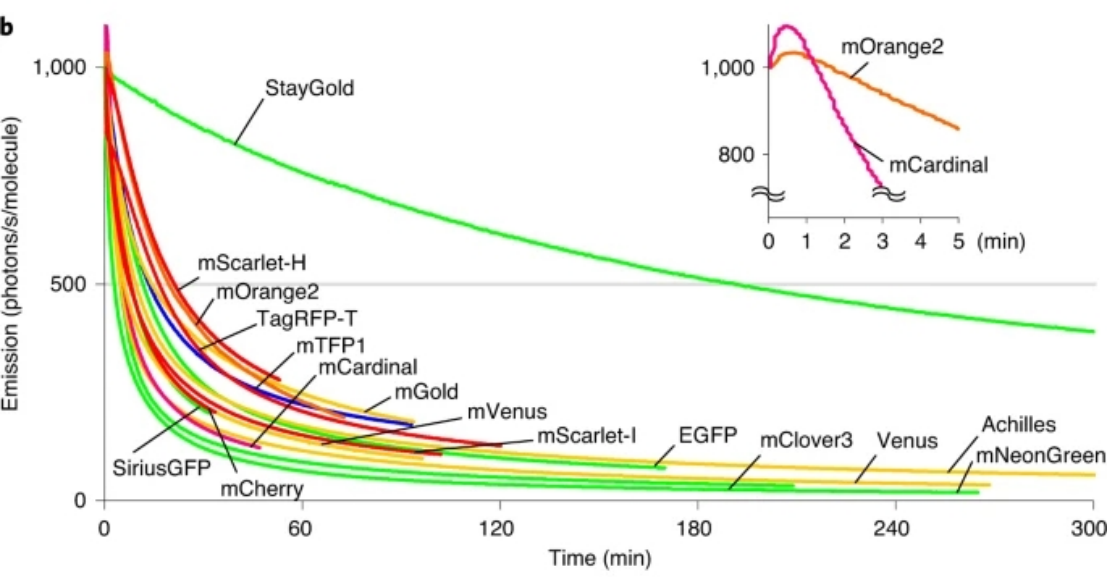
* StayGold has unique photostability.
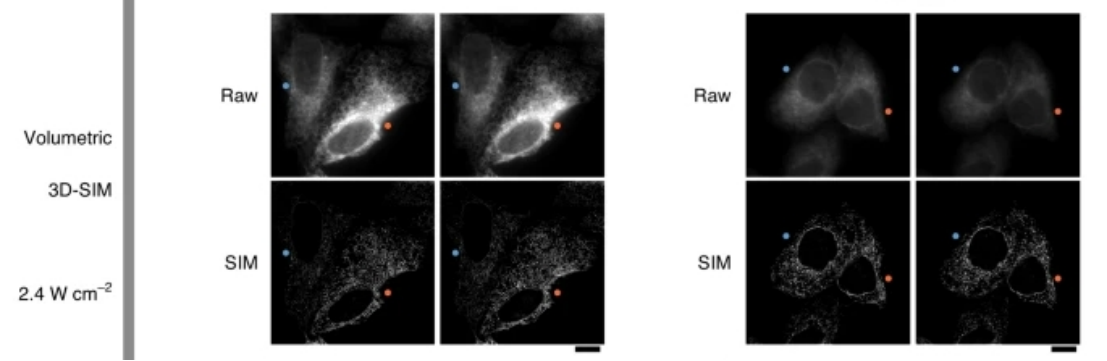
* StayGold fluorescence imaging is excellent (StayGold on the left, GFP on the right).
Anti-StayGold Nanobodies - A Key Tool for StayGold Research
To support this growing field, AlpVHHs has utilized its advanced nanobody and recombinant monoclonal antibody discovery platform to develop highly specific and high-affinity anti-StayGold nanobodies (VHH antibodies), addressing the current lack of suitable antibody tools for StayGold research. These recombinant antibodies provide researchers with powerful and specific tools to detect StayGold and its derivatives in multiple assay formats.
●High Affinity-Anti-StayGold, AlpSdAbs® VHH(HRP)
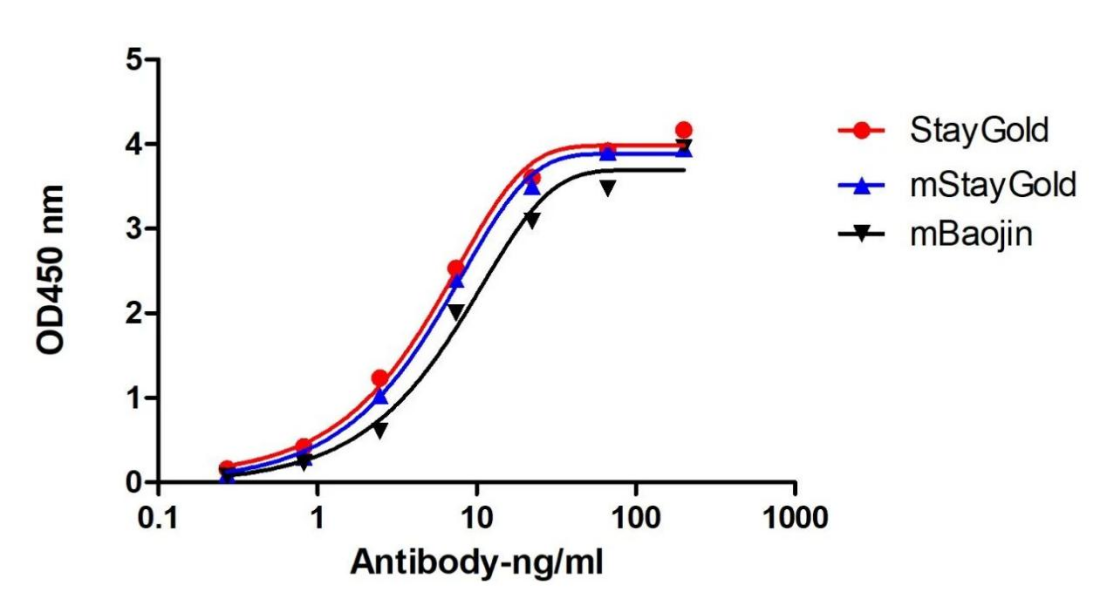
* The Anti-StayGold nanobody (082-101-005) has extremely high affinity and simultaneously recognizes multiple mutants of StayGold, such as mStayGold and mBaojin. (mStayGold was derived from StayGold with the following mutations: N132D/R144I/P151T/L155Q/K162E/H169Y/C174I/Y187F/C208I; mBaoJin was derived from StayGold with the following mutations: *0_M1insMVSKGEEEN/S55T/H75R/E80G/Q140P/H141Q/C165Y/N171Y/T201A/*218KextGMDELYK)
●WB-Anti-StayGold, AlpSdAbs® VHH(HRP)
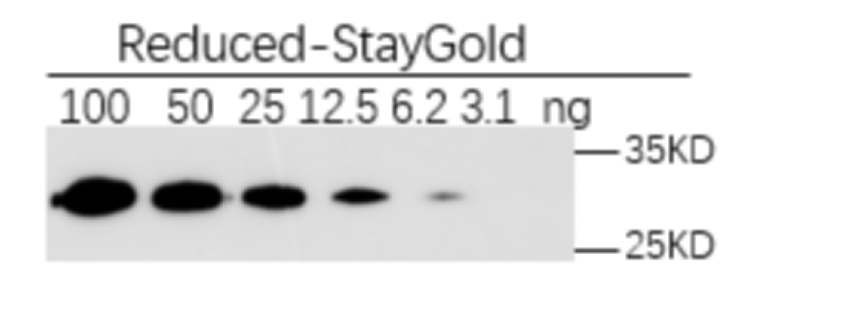
Detection Antibody:Anti-StayGold, AlpSdAbs® VHH(HRP) (1:5k)
* Anti-StayGold nanoantibodies can be effectively used in WB and other tests.
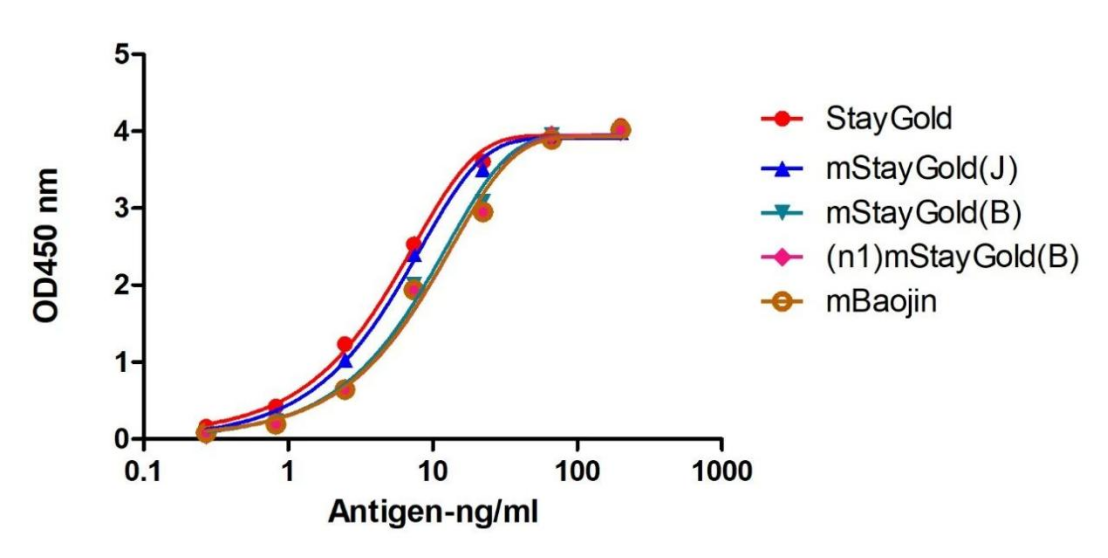
Elisa experiment of different antigen using Anti-StayGold/mBaojin, AlpHcAbs® Rabbit antibody
The plate was coated with different amounts of StayGold or its variants. 1:10000 dilution of Anti-StayGold/mBaojin, AlpHcAbs® Rabbit antibody was used as the primary antibody. Anti-Rabbit IgG(H+L), AlpSdAbs® VHH(HRP) (025-102-005) was used as the secondary antibody.
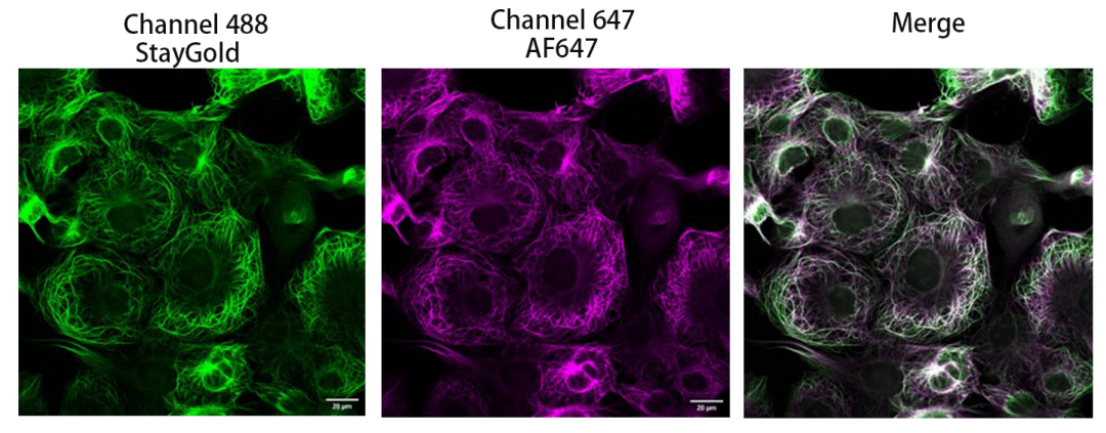
Confocal experiment of StayGold-Ensconsin transfected COS-7 using Anti-StayGold/mBaojin, AlpHcAbs® Rabbit antibody
StayGold-Ensconsin transfected COS-7 cells were stained with Anti-StayGold/mBaojin, AlpHcAbs® Rabbit antibody (1:500) and Goat Anti-Rabbit IgG Antibody(AF647) was the secondary antibody(1:1000). (This picture is kindly provided by Zhang Lab, School of Life Sciences, Westlake University)
Advantages:
●High Affinity: High-affinity antibodies ensure detection of trace amounts of fluorescent proteins.
●Versatile Applications: One antibody can meet diverse assay needs, including Western Blot (WB), IF, IP, and ELISA.
Code | Description | Applications | Size |
082-101-004 | WB,ELISA,IP | 100ug | |
082-101-005 | WB,ELISA | 100ug | |
082-201-001 | WB,ICC/IF,ELISA,IP,Flow Cyt | 100ug | |
082-201-004 | WB,ICC/IF,ELISA,Flow Cyt | 100ug | |
082-201-005 | WB,ELISA | 100ug | |
082-101-002 | IP,CHIP,MS,Purification | 1mL | |
082-101-003 | IP,CHIP,MS,Purification | 1mL |
About AlpVHHs
AlpVHHs is a leading innovator in VHH antibody and nanobody technology, specializing in the discovery and production of recombinant antibodies and recombinant monoclonal antibodies for research and diagnostic applications. For more information, please visit our website www.alpvhhs.com
Mobile/Wechat/WhatsApp: +86-138 8067 6215
Address:Floor 5, unit 2, building 10, No. 319, Qingpi Avenue, Wenjiang District, Chengdu
Email:[email protected]
